Last week I showed my followers how I worked through putting 2,029 companies on the Overton window asking the question, "Would algorithmically understanding this help my chances of finding a product market fit?"
If you missed it, the short version: buyers accept ideas in bands, from "Behind" all the way out to "Unthinkable," and where your offer sits decides who buys it, how you sell it, pricing and how long your cash has to last.
The most common reply I got was some version of: "Cool. Where does mine go?"
And here's the uncomfortable part. When I asked people to describe what they sell, most of them couldn't be placed on the window at all. Not because the window is broken, but because they didn't have an offer. They had a service and a price.
They didn't have an offer. They had a service and a price.
I'm not saying that from a high horse. I did the same thing this year.
And because I'm a little neurotic, I do it all the time. My issue is sitting still long enough to let customers catch up - not getting behind.
I built a subscription website product.
Pay monthly, we build it fast, we keep it updated.
I packaged in Google Business Profile, city pages, call tracking, the works.
I spent real money on ads pointing at it.
And it was slow going.
When I finally graded it against my own framework, the answer was obvious: there was nothing new in it except the way you paid. A website is a Policy band purchase. Every owner already knows they need one.
This was not a new concept in any way - the customer needs something and knows they have to pay for it. Apparently my payment novelty just wasn't enough to turnkey that for most people. Especially now, when AI has every owner wondering what they should actually be buying.
So this week is the part I skipped. How offers actually get made, the ways they break, and a scorecard you can run on yours in about ten minutes.
A service is what you do. An offer is what they get.
Most service businesses describe themselves by their activity.
"We do websites." "We do SEO." "We do bookkeeping."
That's a service. It tells the buyer what you'll be busy with, not what changes for them.
"We do websites."
"We do SEO."
"We do bookkeeping."
"The phone rings more."
"I stop approving every quote."
"I'm not the bottleneck anymore."
And frankly, if more companies really understood the nature of pairing their brand identity to a service, and then that service to an outcome, we'd have a lot more millionaires among us.
An offer has seven parts, and you need all of them:
- A specific buyer. Not "small businesses." The roofing company owner doing $2M to $5M who just lost his office manager.
- A problem they already feel. Something costing them money or sleep right now, not something you think they should care about.
- An outcome, in their words. "The phone rings more." "I stop approving every quote." Not "enhanced digital presence."
- A vehicle. What you actually deliver, how long it takes, and who does what.
- Terms. Price, payment, length of commitment.
- Risk reversal. The thing that removes the main reason they'd say no.
- Proof. Evidence that matches how far out on the window you're standing.
Notice where pricing sits.
It's number five of seven, at least in my model.
My subscription product put all its novelty into number five and left the other six looking like every other web shop in town.
That's the most common mistake I see, and it's an expensive one because ads will happily spend money telling people about a payment plan.
Maybe you're someone trying a new way of solving someone's problem with software, for most people that is not going to be new. You're just another model of operating at a different pricing structure, and you're all clamoring with the same outcomes, messaging and tactics of getting that money.
When push comes to shove, people want new services, but they also want novel outcomes with it, from my perspective.
How offers actually get made
This is the order I'd build one in now. It's not glamorous, and most of it needs to happen before you start executing.
In the world of Threads and X, I see more and more people talking about how the only thing that matters is your execution.
Those do matter.
But executing with a shit plan will put you in a world of hurt. You may get there eventually, but it will be bloody.
Try these out:
1. Start with a buyer who is already moving. The first question isn't "is this a good idea?" It's "is anyone already looking for this?" Search volume, people asking in groups, competitors with waiting lists, your own inbox. If nobody is actively shopping for the outcome, you're not building an offer. You're building a category, and that's a much more expensive job. Some people should do that. Most service businesses shouldn't.
Find this buyer without AI, from experience, because if you ask AI you will land in the SAME spot as everyone else. The goal here is genuine novelty, which as of today, it struggles to even come close on.
2. Write down the job in their words. Go get the actual language. Call five past clients and ask what was going on the week they decided to hire you. Don't have those? Call five industry business owners and ask them. Read the reviews on your competitors. You're looking for the sentence they say out loud, not the one you'd put in a pitch deck. "I'm tired of being the bottleneck" beats "operational efficiency" every time.
3. Decide where you're standing on the window. This is where last week's post earns its keep. If you're in Policy or Popular, the buyer already knows the category. Your whole job is being the one they pick, so speed, specialization, and a guarantee matter more than cleverness. If you're in Sensible, you get one good explanation, then they pay. If you're in Acceptable or further out, you need early adopters and heavy proof, and you need the cash to wait for them.
The band tells you how much explaining you're allowed to do. Most offers fail because they ask for more explaining than their band allows.
4. Build the vehicle. Now you design the thing. What exactly gets delivered, by when, and who does it. Be specific enough that a buyer can picture week one. "First draft in 7 days" is a vehicle. "A collaborative design process" is a fog machine.
One question I didn't used to ask here: can this be delivered well without me? If the offer only works when the founder does the work, it isn't an offer. It's a job with a sales page.
5. Set terms that match the band. Price and payment structure should feel normal for where you're standing. Inside the window of familiar products and services, buyers expect familiar terms, so unusual pricing reads as a catch. Further out into the world of novelty, buyers expect to pay more for being early. Terms support the offer. They are almost never the offer.
6. Remove the one risk that actually stops them. Not every risk. One. For a website it's usually "will I own it, and can I leave?" For a fractional hire it's "what if this person doesn't fit?" For a service it's usually, "what if what you do doesn't fix my problem?" Find the real objection and design the offer so it disappears. A 90-day test engagement does more work than any testimonial. Same with a money-back guarantee. Same with a free trial.
7. Sell it to ten people before you buy a single ad. DMs, calls, a short email to your list. If you can't close a few of ten warm conversations, ads won't save it. Ads amplify an offer. They don't fix one. I learned that one with my own money.
Ads amplify an offer. They don't fix one.
Five ways offers break
When an offer isn't working, it's almost always one of these. I've done at least three of them personally.
The payment plan pretending to be an offer. Subscription, financing, retainer, "no contracts." All fine as terms. None of them make a default purchase feel new. If the only thing you could change about your offer without changing the deliverable is how people pay, you haven't found the offer yet.
The kitchen sink. You bundle six services so the price feels justified. Now the buyer has to understand six things to buy one. If your tiers need a comparison table to explain, the buyer is doing your positioning work for you, and most of them won't.
The claim that sounds too good. Big savings numbers, "unlimited" anything, guarantees that would bankrupt you if three people took you up on them. People don't trust much right now. Boring and specific beats big and vague. You have to be able to quickly prove what you say.
Novelty in the wrong place. A new deliverable sold to a buyer looking for a better price or someone who just wants the normal thing done well. Or a totally familiar service pitched like a breakthrough. Either way, the buyer feels the mismatch before they can explain it.
The offer that needs the founder. It sells because you sell it and it's good because you do it. That works until you want a weekend, a second client, or a buyer for the business. If it can't survive you stepping back, it's a really nice job.
The rule: new in one place, familiar everywhere else
If I had to shrink this whole post to one line, it's this.
From my experience, a good offer solves the customer's pain better than other options while making it less risky to purchase, and doesn't try to reinvent every wheel, just the one the customer sees as necessary.
The buyer should be able to file it under a category they already buy. The terms should feel normal. The proof should look like proof they've seen before. Then there's one difference that matters, and it's easy enough to say in a sentence.
That's why the positioning template (I know it's way overly simplified) has a slot for "the category they already know" and a slot for "the one difference that matters."
The goal for most of us is finding the one thing worth being different about and making everything around it easy to say yes to.
Fix your offer before you spend on it
I built a workbook that walks you through some of my thinking model on this and should help you understand:
- Why you get views and engagement but no leads.
- Why people inquire, but don't buy.
- Why your offer is so hard to explain.
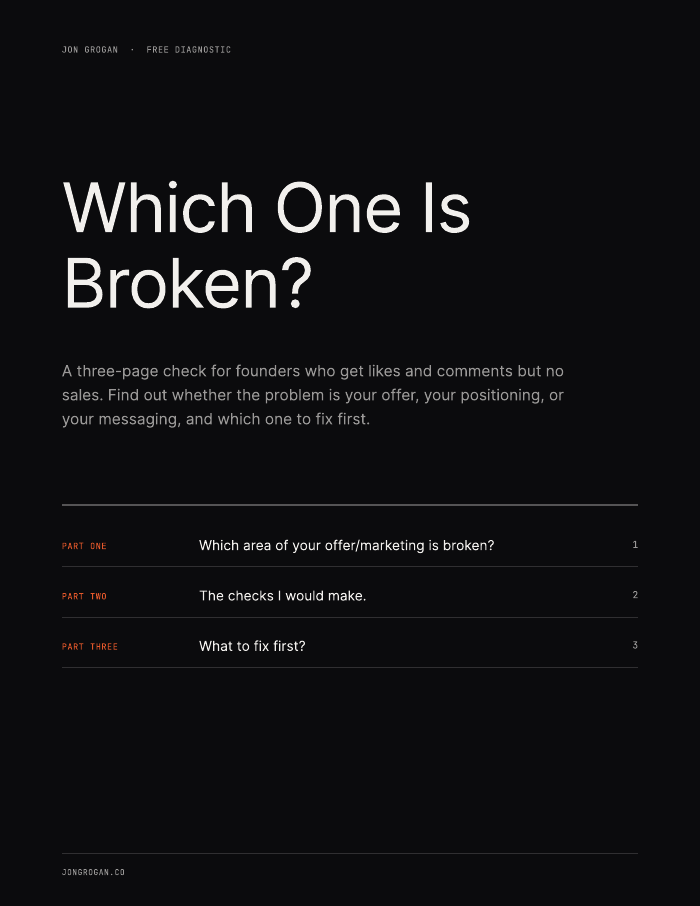
Fix Your Offer
For founders who get views and engagement but no sales. Fifteen yes or no questions that tell you whether your offer, your positioning, or your messaging is the problem, and which one to fix first.
- Why you get views and engagement but no leads
- Why people inquire but don't buy
- Why your offer is so hard to explain
Test this and let me know how it works.
And like last week, if you score yours and want a second set of eyes, reply and send me the info after you've done the work and the one line version of your offer. I read every one.
One caveat. If you ask an AI tool to score your offer, it'll usually be generous and push you toward the moderate answer. Do the scoring yourself, and be meaner than feels comfortable.
Onward.