The all too familiar feeling
You look at the numbers on a Monday morning, decide growth feels too slow, and reach for the most respectable fix in business. For some of you this means fewer leads. For some of you just starting out, you’re still trying to figure out why the heck you can’t seem to get sales at all.
So you follow some kind of Hormozi style tactic - you start posting every day, sometimes twice a day.
You crank up the ads.
You even call back Lamar and spin up a billboard.
Hell - at this point you add another new marketing channel because you’re sure that it can’t hurt, right?
Post twice a day.
Crank up the ads.
Call Lamar for a billboard.
Add another channel.
Fix the offer first.
Fund what's working.
Cut what isn't.
Test for 90 days, then decide.
On paper, that looks like discipline.
Inside a small business, it mostly feels like running out of hours by Wednesday while revenue sits right where it was a month ago.
I’ve been on the inside of some rough situations. I remember helping small businesses during covid that had no digital architecture. One day everything was going great, and then all of the sudden - crickets.
The reality for most of those businesses is the same reality for you today, whether you believe we’re in a recession or not. From cycling coaching to plumbing to digital marketing & creative agencies - good marketing comes down to systematic decisions based on trial and response with your ICP (ideal customer profile).
I kept thinking about this this week after a few posts on Threads turned into a longer conversation than I expected. I write a lot that most marketing problems start with the offer (I’ll even soon have a course up), and that if people don't want what you're selling, more posts and ads won't fix it.
Then I wrote that most owners don't need digital products, three marketing channels, and tons of leads to reach a million in revenue.
Nobody argues with the effort. What readers asked was much fairer: how do you know when to stop adding volume, and how do you tell whether you have an offer problem or a reach problem?
How do you know when to stop adding volume? Great question. And you might not like the answer.
Last week we covered how offers get made, and why most companies have a service and a price instead of an offer.
This week is the step right after that: why doing more keeps failing you, how to tell offer from reach before you spend another dollar, and how to make fewer hits land harder when buyers get careful.
If you give me a shot, I MIGHT just be able to save you from hustle culture. 😊
Doing more is the default, and it's an expensive one
When revenue stalls, "do more" is the first prescription you hear.
And it makes sense. If your tribe doesn’t have enough food to eat, your caveman brain is immediately going to start thinking - “NEED MORE FOOD”.
What’s difficult for most of us is that we’ve been born into a timeline where hustle culture exists. And hustle culture is a different animal.
Hustle culture takes a spin on that caveman brain and says - I don’t care if we have enough, one day I might not, I have to work harder.
It will push you past all health warnings, it will push you past boundaries with your family, missed soccer games, missed recitals. You name it.
Imagine this for a second. A caveman with so much food in storage that it's spoiling, and he keeps working to the point of struggle simply because, “what if I stop and there's no more…”
Be a really stupid movie, right?
Your work always comes with a cost. Say I run a business doing a million dollars a year.
If I pay well, give good benefits, and like to keep things lean, my value per employee would need to be around $250-$400k each year. If I dip below that, growth is hard.
In that business, an hour of my time would be worth about $208.
So I have to make sure the things I spend my time on are worth that $208. Otherwise I'm paying myself to perform a marketing task that isn't yielding anything.
If I’m going to spend my day focusing on something, I have NO BUSINESS wasting it on random social content that yields nothing. I have a rate to keep.
And while I like AI, it's a really crappy replacement for the real thing when it comes to matching my writing and tone.
That means I have to be SUPER efficient with my time. Get the posts out that yield good results, build good community and MOVE to something else. If I want to do more, I have three options:
Clone myself. We don’t have the technology.
Delegate. Using AI isn’t always the right decision. An employee could work, but at that point there is a cost associated with their time too, so it needs to be profitable.
Maximize my profit. Figure out how to get more juice out of the same orange.
My goal in business with my customers is the last.
Once your needs are met - following the caveman analogy - it makes no sense to work yourself to the grave to build your profit. I believe you can build HIGHLY profitable businesses while keeping your health.
Moving away from the stockpiling analogy - you also run the risk of confusing your customer by doing more. More ads can mean you end up using the wrong channels. More posts can mean unfollows. More emails mean unsubscribes.
The name of the game is making your time and strategy simple, meaningful and more and more profitable.
I'm not saying that from a high horse. When I get restless in my own work, my first instinct is to build another thing. I promise you from experience… this is the wrong move.
Focus, even for groups like Y Combinator, still remains one of the greatest indicators of a good investment.
Earlier this year, like I told you last week, I built a subscription website product - Google Business Profile, city pages, call tracking, the works - and pointed real ad money at it. When it moved slowly, my first impulse wasn't to stop and admit only the payment terms were new. It was to tweak the copy and push harder on distribution.
And like I told you last week, this idea of doing more caused me to miss the fact that the offer itself was wrong.
Trying to grow with brute force causes us to miss the details that we need to see to ensure we are on track.
When you slow down and cut the volume, you start to notice when people really don’t connect with something you’ve made.
There is no timeline, no hard work and no amount of grit that can make a bad offer that no one wants profitable.
Most owners don't add volume because they are reckless. They add it because activity is easier to count than judgment.
You can count thirty posts in a month, send thousands of messages with AI through your Threads or X account, or watch an ad manager spend fifty bucks a day, even if nobody on the team can point to one booked job it produced.
And why do we do it?
Activity is easy to count. Judgment is uncomfortable, because it asks you to stop doing things you already spent time building.
In a small business, there usually isn't a spare marketing department waiting in the back.
"Do more" comes out of the owner's evenings, or out of a small team already stretched across fulfillment, invoicing, and answering the phone.
Spread that team across three channels and two side offers, and everything gets done to sixty percent. Then the owner looks at the flat bank balance and decides marketing doesn't work in their industry.
More marketing won't fix a bad offer
Recently, I posted one line on Threads: "More marketing won't fix a bad offer."
Posts like that always do the same thing for my account - just business owners arguing through a problem in the comments.
Later that night I posted the line that usually gets pushback: "'Post more' is the advice I disagree with most. Volume doesn't fix a message nobody understands. It just spreads it around faster."
If ten prospects hit your site and eight leave without knowing who it's for, what changes for them, or why it's safer than doing nothing, buying ten times the traffic doesn't fix the confusion. It buys eighty confused visitors instead of eight.
Volume, ads, posts - they all amplify an offer. They don't fix one.
Posting every day works the exact same way, multiple times a day, sending multiple weekly emails on a bad offer - you name it. If five clear posts naming who you help and what you fix aren't starting conversations, thirty posts written in the same fog will only keep you busy.
I’ve accepted that most of my social media falls into a category of “Brand Awareness” for me.
If you follow a traditional AIDA (awareness, interest, desire, action) funnel - that’s just the top of the funnel.
More posts aren’t going to help push people down the funnel, but I can usually see if my offer is wrong for the group I’m talking to. You won’t get sales if people don't walk down the funnel, and if volume doesn’t fix that, you have to figure out what does.
How do you tell if it's the offer or the reach?
Knowing this is more art than science. It will take a bit of testing and collecting data, but then you will have to read the room.
They leave very different footprints.
If it's a reach problemAlmost nobody in your buyer pool has seen it yet. Views are tiny, or the people liking your posts are mostly peers rather than people who write checks in your category. When you put the same description in front of five or ten actual buyers by phone, email, or DM, a few lean in right away.
If it's a messaging problemBuyers stop to look and get stuck on what you mean. They ask what's included or how it works. You rewrite your bio or headline every few weeks because even you feel it missing. They aren't rejecting the outcome; they just can't repeat back what you sell in ten seconds.
If it's an offer problemPeople understand what you sell and still keep their wallet closed. They like the post, say "this is great," maybe ask the price, and vanish. Or they compare you against three cheaper options and pick on price, because nothing in your scope, terms, or risk reversal gives them a reason to act now instead of waiting six months.
Reach problems are obvious. Offer problems feel polite.
When you have reach and a weak offer, people nod along and don't buy. Buying more impressions on top of polite indifference won't turn politeness into revenue.
Fewer tasks, but more results
This looks different based on your size.
If you’re an existing company with a good client base trying to figure out how to optimize your marketing, then your solution is not to stop everything and start over, it’s to evaluate the profitability of everything you’re doing in the funnel.
If you find marketing decisions that are not yielding outcomes, stop them.
Test before you start something new.
Don’t let unprofitable marketing tactics run longer than ninety days.
If you’re just getting started and under $10k a month, you have a decision to make.
Does your marketing do anything right now? Can you name 10 good leads in the past 90 days? If not, stop everything and start from scratch and develop two things:
- One good channel you own. Email is a good one, but something that doesn’t go away without use and something that doesn’t cost you to use.
- One good channel you borrow. For most of you this is social media, but this is something you may need to spend a little money to use. Don’t just use a channel because you like it. You have to be able to find people on the platform that fit your ICP.
EmailOne channel you borrow
Where your ICP already isTest for 90 daysEvaluateDecide what stays
The rest is easy.
Test 90 days, evaluate, then decide what to do.
When you narrow to one clear buyer, one real offer, and one or two places your customers already check, every choice carries weight.
Your website speaks to one buyer instead of apologizing to six, your email list hears something useful every week, and sales calls start warmer because prospects read something specific before picking up the phone.
Even when money is tight
People keep asking whether this still holds right now if we head into a recession or if buyers keep pulling back.
We’ve all heard the “buy the dip” philosophy in trading, but it really works in marketing.
Most people get conservative in recessions. Your job is to take market share and grow.
Even without guessing at macro headlines, the math inside a small business doesn't change when budgets get careful. A tight market is the worst time to run the "do more" playbook and cut expenses.
If this sounds counter-intuitive or like I’m contradicting myself, you’re missing the point.
Hustling tells you to personally do more and bring it in house.
I’m telling you to triple down on what’s working, cut the excessive tactics and take market share by funding what’s working.
Don’t make more posts, fund the campaign that gets you leads at $34 a pop.
When cash moves freely, vague marketing hides for a long time. Prospects take exploratory calls and buy retainers they barely understand because revenue is up.
When buyers start watching every invoice, that cushion disappears first.
A cautious buyer doesn't stop spending on problems costing them money or sleep. They stop spending on things they can't explain in one sentence to a business partner or controller. They skip vague retainers, pull back when pricing feels hidden, and weigh every pitch against doing nothing.
In a slower market, trying to out-post or outspend a fuzzy offer gets expensive fast. Acquisition cost climbs right as close rates drop. The businesses that hold up - or take share while louder competitors cut back - trim the side projects nobody asks for twice, tighten the core offer, talk straight to their email list, and reply fast with a clear price.
You don't win a careful market by making more noise.
You win it by making fewer promises that are easier to believe, actually delivering on them, and putting them right where a buyer with an active problem is looking.
A short check you can run this week
Before you add a channel, raise your ad budget, or write thirty more posts, sit down with paper and run four checks on what you already have.
Don't ask an AI tool to grade it - it will meet you in the middle and tell you everything looks fine. Be meaner than feels comfortable.
Check one. Audit your last ten inquiries, not your total views. Pull the last ten people who filled out a form, replied to an email, or asked what you charge. How many became real buying conversations, and where did the rest stall? If they went quiet right after you explained what you do or sent the quote, traffic isn't your leak.
Auditing your marketing channels is easy:
It's simple. You’re following the flow chart to exactly where it broke. Knowing where they drop off fixes a multitude of bad spending.
Put one sentence in front of a stranger.Show your homepage headline or bio to someone outside your industry and ask what you sell and who it's for. If they hesitate or hand you buzzwords back, fix the message before buying attention.
Separate your warm test from cold spend.Have you sold this exact offer - same scope, same terms, same risk reversal - to people you can already reach by phone, email, or referral? If it won't close warm, paying an ad platform to show it to strangers won't save it.
Pick one thing to stop doing for thirty days.Park one channel, side offer, or weekly task that eats hours without starting real conversations, and move those hours back into your primary offer and follow-up.
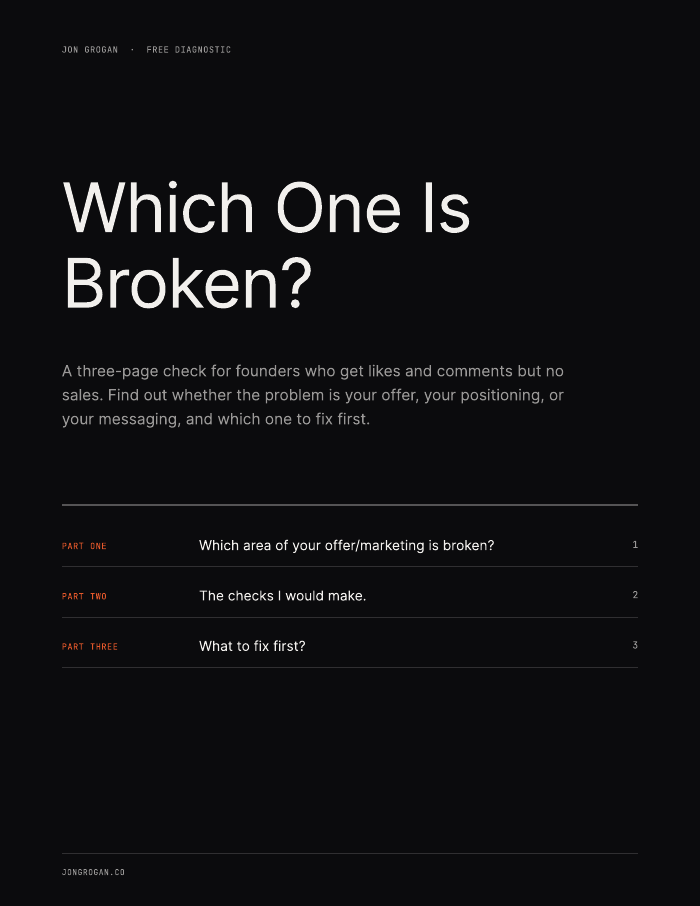
Fix Your Offer
For founders who get views and engagement but no sales. Fifteen yes or no questions that tell you whether your offer, your positioning, or your messaging is the problem, and which one to fix first.
- Why you get views and engagement but no leads
- Why people inquire but don't buy
- Why your offer is so hard to explain
If you want a second set of eyes
If you've been working harder on marketing every quarter while revenue stays flat, I know how exhausting that gets. It's tempting to tell yourself you just need more consistency or a slightly larger budget next month. Most of the time, the business doesn't need more action. It needs help sorting through the data.
If after checking, you still aren't sure whether you're staring at an offer problem, a messaging problem, or a reach problem - reach out to my email or schedule an initial call. I answer my own email and look forward to connecting.
Onward.